Bruce Sterling coined the term "spime," which is an object that can constantly be kept track of. An example of such would be a car with a GPS. A working GPS constantly shows the driver the position of the car on a map. The GPS is connected to a network of some sort, that means someone has the potential to locate the car remotely.
Anything that can be located remotely is a spime. Spimes are becoming very common today because of the advancement of the internet. Any kind of device, be it a desktop computer or a cell phone, being connected to the internet is not uncommon.
A professional Baseball team can even be considered a spime. (Such as the New York Yankees.) During the baseball season, the press constantly follows the team around to give the public updates on how the players are performing and where they're going to travel to next. All of this information can be accessed remotely on the internet on the computer or even on a cell phone. It's a strange concept, but through the internet, almost anything can be a spime.
IDD 250
Monday, November 28, 2011
Tuesday, November 15, 2011
Usability mistakes
Facebook.com doesn't have a bad layout, it's very easy to use once you know what you're doing. But for someone new to Facebook, it can be very confusing. One thing Facebook does wrong is that it constantly changes its layout. As soon as people have gotten used to the new layout, the web designers feel like it's a good idea to change it again. Maybe by moving the location of the "logout" button or putting videos and photos on the same page. At first the designers might think that the changes make the website easier to use, but that's probably only because they are the ones who came up with these ideas. Whenever the layout changes, nobody knows where everything is. It's one of those websites where, unless you've been on Facebook for a while, you're not going to understand what everything means.
There are advertisements on the right side of the screen that are often false, or just plain strange; and on the right side of the screen you'll see applications, pages and groups. Facebook, as of late, has blurred the line between group pages, and regular pages. Those two types of pages pretty much do the same thing. Anyone a part of a group gets the group status updates, and anyone who liked a page will get the page's status updates. Having two types of pages that do the same thing is confusing because there can be a group for a certain topic, and a page for that same topic and people will just join both. That's a very pointless feature.
Overall, Facebook's biggest flaw in it's usability is how its navigation is constantly changed.
Tuesday, November 8, 2011
Cyberdrama
A video game called "Shadow of the Colossus" is an excellent example of cyberdrama. The game does an excellent job telling a dramatic story with minimal dialogue. The game tells a story of a boy who wants to bring a girl back to life, and in order to do so, he must defeat 16 giant monsters called the "Colossi."
The player has very little influence on what happens in the story, the player is limited by the creators of the game. This isn't necessarily a bad thing because this way the story doesn't have branching story-lines, this way the developers were able to concentrate on telling one compelling, interesting and immersive story-line.
Even though the player has no influence on how the story ends, the game does a fantastic job of making the player feel like they did, or at least had the opportunity to change the ending. The game gives the player the illusion of agency. (Having an impact on the world.) During the last scene of the game, there will be a few moments in which you're given control of the main character, but no matter what you do, the outcome will always be the same. Because you're given the illusion of having a window of opportunity, but then forced to miss that window, you feel like you're a part of the story because it makes you feel like you actually messed up. This makes the player feel like their a part of the game by making them feel like they could've changed the ending.
Tuesday, November 1, 2011
The six qualitative elements of structure
Persona 4, a video game for the Playstation 2, is a lot like an interactive drama. It's got the six qualitative elements of structure in drama, and while playing this game, the user uses or alters all six of them.
Action: When playing this game, no actions will happen unless the player does something. It is "collaboratively created between the system and the user." The user presses buttons to make what he/she wants to happen, happen on the screen. The user tells the game what actions he or she wants, which is an action in itself, the game then preforms these actions.
Character: There are pre-defined characters in the game that you meet up with, but you define your own character the way you want to. The game even allows you to have an impact on how other characters change.
Thought: The user does a lot of thinking in this game. There are many choices he/she can make, so they think a lot about how they want the story of the game to unfold. Because the player is playing the role of the main character, the main character is communicating the player's thoughts to the characters in the game.
Language: When given several responses to choose from when interacting with characters, the user is allowed to choose the connotation in which to respond. If it's someone you don't like, then you might choose a rude response. This is how the user has control over language.
Melody: Based the choices the user makes, different things can be heard throughout the game. Such as different songs or different dialogue.
Spectacle: Based on the choices the user makes, different things can be seen through the game. Such as different friends or different enemies.
Action: When playing this game, no actions will happen unless the player does something. It is "collaboratively created between the system and the user." The user presses buttons to make what he/she wants to happen, happen on the screen. The user tells the game what actions he or she wants, which is an action in itself, the game then preforms these actions.
Character: There are pre-defined characters in the game that you meet up with, but you define your own character the way you want to. The game even allows you to have an impact on how other characters change.
Thought: The user does a lot of thinking in this game. There are many choices he/she can make, so they think a lot about how they want the story of the game to unfold. Because the player is playing the role of the main character, the main character is communicating the player's thoughts to the characters in the game.
Language: When given several responses to choose from when interacting with characters, the user is allowed to choose the connotation in which to respond. If it's someone you don't like, then you might choose a rude response. This is how the user has control over language.
Melody: Based the choices the user makes, different things can be heard throughout the game. Such as different songs or different dialogue.
Spectacle: Based on the choices the user makes, different things can be seen through the game. Such as different friends or different enemies.
Tuesday, October 25, 2011
Transmedia Storytelling
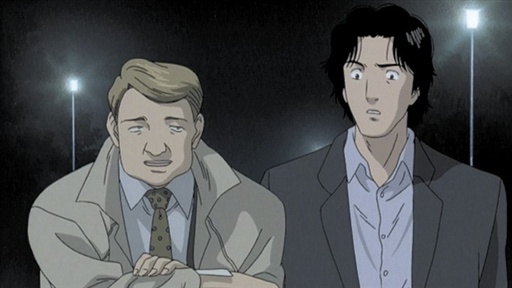
The story of Noaki Urasawa's Monster is a story about a doctor named Kenzo Tenma in Germany in the late 1900s who saves a young boy's life. 10 years later that boy, named Johan, grows up and becomes a serial killer and Kenzo Tenma is framed for the murders that Johan commits. The story is told through two different types of media: an anime (Japanese for animation) and a manga. (Japanese for comic.)
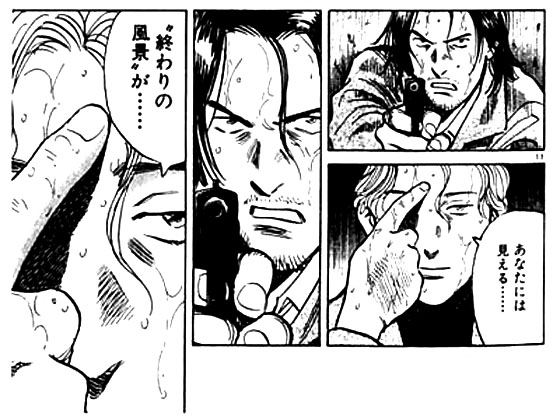
Both the anime and manga tell the same story, but in different ways. One volume in the manga would probably be 3-5 episodes in the anime. The manga came first and is has the original story by Noaki Urasawa, and then there was an anime made based on that manga, but some of the major plot points and characters are different. This can make the experiences of watching the anime and reading the manga different.
Here's Noaki's Urasawa's Monster as an anime:
Here's what the original manga looks like:
Both the anime and manga tell the same story, but in different ways. One volume in the manga would probably be 3-5 episodes in the anime. The manga came first and is has the original story by Noaki Urasawa, and then there was an anime made based on that manga, but some of the major plot points and characters are different. This can make the experiences of watching the anime and reading the manga different.
Here's Noaki's Urasawa's Monster as an anime:
Here's what the original manga looks like:
Tuesday, October 18, 2011
Remediation
Hypermediacy:
This is a screenshot of someone's video on Youtube. Videos that aren't being watching in full screen are a prime example of what hypermediacy is. The user is fully aware of the medium being used to watch the video because the video only takes up a small portion of the screen. Seeing "Youtube" at the top of the screen, and links to other videos all around the page reminds to user of the medium.
Immediacy:
A computer game that takes up the whole computer screen is a prime example of immediacy. The screenshot above is of a game called "Amnesia the Dark Descent." As you can see, while playing the game there is no user interface to give the player a sense that they are actually in the game. The game developers themselves put a notice in the game that encourages people to play the game while wearing headphones in the dark for the most immersive experience. While playing a game such as this with minimal user interface, one sometimes forgets about the medium being used.
Redmediation:
Above is a screenshot of Google Earth. This is a good example of remediation because what Google is, is a recreation of all of Earth. Through Google Earth, people can zoom in on specific parts of the world and see maps of any location they want.
This is a screenshot of someone's video on Youtube. Videos that aren't being watching in full screen are a prime example of what hypermediacy is. The user is fully aware of the medium being used to watch the video because the video only takes up a small portion of the screen. Seeing "Youtube" at the top of the screen, and links to other videos all around the page reminds to user of the medium.
Immediacy:
A computer game that takes up the whole computer screen is a prime example of immediacy. The screenshot above is of a game called "Amnesia the Dark Descent." As you can see, while playing the game there is no user interface to give the player a sense that they are actually in the game. The game developers themselves put a notice in the game that encourages people to play the game while wearing headphones in the dark for the most immersive experience. While playing a game such as this with minimal user interface, one sometimes forgets about the medium being used.
Redmediation:
Above is a screenshot of Google Earth. This is a good example of remediation because what Google is, is a recreation of all of Earth. Through Google Earth, people can zoom in on specific parts of the world and see maps of any location they want.
Monday, October 3, 2011
Post Secret
PostSecret.com is a website in which people write down their secrets on a post of some sort and have them uploaded online anonymously. It's a continuing community art project that's continually updated with the secrets people send in.
But some of the things on the site aren't necessarily secrets, they are messages. Such as this one that's trying to raise awareness of children diagnosed with cancer and advocating for a cure.
The message this website sends is an interesting one. I feel like what it's trying to communicate is that fact that everyone has done something that they resent, and that no one is perfect. By allowing people to post secrets that they may not be proud of anonymously, it gives people the confidence to do so because no one will find out it's them. And some people take that ability and put an interesting spin on it to advocate doing the right thing, such as this cancer awareness post.
This website is laid out just like a blog, that's a common layout I see in many other websites. Other websites that rely on user-submitted content use the blog format because it's easy to update and it's easy for viewers to keep track of these updates. The latest post by a user is on the very top of the page.
Websites like these are updated often because it's kept alive by a large community of people. It's an effective website because it's easy to read everything top to bottom, and each post tells an a short, interesting story.
But some of the things on the site aren't necessarily secrets, they are messages. Such as this one that's trying to raise awareness of children diagnosed with cancer and advocating for a cure.
The message this website sends is an interesting one. I feel like what it's trying to communicate is that fact that everyone has done something that they resent, and that no one is perfect. By allowing people to post secrets that they may not be proud of anonymously, it gives people the confidence to do so because no one will find out it's them. And some people take that ability and put an interesting spin on it to advocate doing the right thing, such as this cancer awareness post.
This website is laid out just like a blog, that's a common layout I see in many other websites. Other websites that rely on user-submitted content use the blog format because it's easy to update and it's easy for viewers to keep track of these updates. The latest post by a user is on the very top of the page.
Websites like these are updated often because it's kept alive by a large community of people. It's an effective website because it's easy to read everything top to bottom, and each post tells an a short, interesting story.
Subscribe to:
Posts (Atom)